Sunday, January 23, 2011

A homegrown meal

Garden harvest
 
Mary, Mary, quite contrary how does your garden grow?

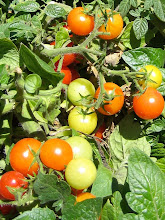
Quite well, at the moment. It's so lovely to see my zucchini plants and 25+ tomatoes taking off. I had a lovely meal last night, mainly harvested from the garden. I made a couscous salad that included beetroot - chioggia (has red and white concentric circles), lettuce - cos purple freckle, mint, purple sage, a squeeze of lemon and the first tomato - a yellow cherry tomato! Very happy with my harvest, which I dressed with olive oil and balsamic vinegar, plus a chévre (goat cheese) from nearby Milawa Cheese Factory.

I have either grown my vegetables and herbs from seed or from cuttings from friends and the lemon tree was here way before me.

Comparing paying for seeds to seedlings is huge. If they don't all germinate, oh well, you haven't really lost much money. Just a few cents. So just give it a go. Not all the beetroot germinated but that's ok. So if you want to penny pinch, buy a packet of seeds and try it out. Go crazy with all the different varieties available that won't be sold as seedlings.

You'll end up with too many seeds than you can use in a year, so share amongst your friends. It's a bit of an insurance policy, too. The germination rate of the seeds will decline over time, so if a few of you are growing a variety then if one of you should run out, someone else will have them. I shared my seed box with my workmates. It did a lap of the office before it got back to me. It made me happy that others were going to use them.

About six or so beetroot grew, but I gave most to my Mum so the remaining one in the garden is for seed harvesting. Try and buy the seeds once, save them from the next harvest so you never have to buy again. What an investment! Apparently, the chioggia beetroot was grown as a staple in 1583 in Venetian cuisine!

 Beetroot Chioggia

Monday, December 27, 2010

Native Grass

 Kangaroo Grass
Before this year, I never thought native grasses still existed on farmland. I'd grown up with the idea that you sow seed for "improved pasture". Clovers, ryegrass, phalaris and such. I thought with the high impact of stock and tillage native grasses would have been banished to state forests.

I was very pleased when my friend identified a few native grasses on my plot earlier this year. I'm new to identifying them, but am excited they exist. I have since discovered that it isn't so bizarre to have native grasses on farms and with careful management, such as holistic management which uses stock for an intense period and then rest, you can have a diverse array of native grasses. As they are native to the area, they are a somewhat more reliable pasture plus don't cost you to establish.

I knew one corner of the cleared area of my plot had native grass. The other day I noticed a second patch of Kangaroo Grass (Themeda triandra). It has a lovely red this time of year (summer) and has become a more rusty red since I took this photo.

The other I have noticed is Weeping Grass (Microleana stipoides).

Weeping Grass

In December there was a big flood in the King Valley: bigger than in September. The lower parts of my plot were flooded. The water from the road also cut across the plot, flattening the very tall phalaris so I could easily see its path. Principle One in permaculture is Observe and Interact. This was an excellent way to observe!

In my permaculture design of the plot, I had thought the lower area may be prone to flooding so have factored this in. Now it has been confirmed. The trees I had planted were higher up on the slope, so out of harm's way.

The flood also did a fantastic job pushing a lot of blackberry out of the way. If I can get stock in to knock it around some more, I may maintain good access for me to walk to the creek on the north side. The flood dumped so much sand around the creek, a potential new resource for me.

The Black Locust (Robinia psuedoacacia) forest creates a lovely light. It is a welcome retreat from the scorching summer heat (up to 40 degrees) that is sure to come in the next couple of months.
Black locust

Monday, December 13, 2010

Joel Salatin Workshop

Free range pigs

Farming really does pay. Just ask Joel Salatin, of Food Inc fame and owner of Polyface Farm. Farming can support a family plus keep on supporting additional family members. All this while farming "beyond organic" rather than the current industrial agriculture model. How this all works, the nuts and bolts of Polyface Farm, is what I was priveleged to hear about at the two day workshop on Local Farms and Community by Joel Salatin. The last RegenAg workshop for 2010 (can't wait until the 2011 series, despite the FarmReady budget running out for this financial year).

Joel is a very charasmatic farmer and a great communicator from the USA. His farm focuses on growing pasture. His family have taken a degraded landscape that had lost significant amount of topsoil and turned it into a lush farm supporting (or supported by) various animals. The animals are allowed to express their natural behaviour which in turn regenerates the landscape. For example, birds in the wild tend to follow herds and thereby reduce parasites. Hence, the chickens follow the cattle around the paddock on rotational grazing, scratching through cow pats and eating bugs. Pigs love rooting things up, so the pigs turn dropped hay, cow manure and sawdust into compost while looking for the corn that has been sprinkled through it in layers over the very few weeks the cows are fed hay in the shed.

On the first day, Joel took us through the various elements of Polyface Farm:
  • Salad bar beef
  • Pasturised poultry (chicken eggs and meat, turkey)
  • Pigaerator pork
  • Forage-based rabbit
  • Forestry
One of the past interns has recently begun a horticulture enterprise, so it will be interesting to see how that progresses.

Integrate rather segregate is one of the permaculture principles that Joel is excelling at. It has really made me think about including a substantial pasturised poultry enterprise at my plot because a) animals offer such an invaluable environmental service in fertilising and pest control and b) there is money in it.

The second day was on marketing and who is going to do the work. Joel's focus is on selling direct and local. This is all about creating local jobs. Selling direct also means the farmer gets a good price for the produce (I have been told five to one is the common ratio between retail price and the price the farmer gets). Hence the oft quoted line "there's no money in farming", which hardly entices the next generation to keep on the farm. Plus so many farmers are having to supplement their income by working off farm.

I was impressed by the Metropolitan Buying Clubs. Similar to a Community Supported Agriculture scheme, but with more flexibility. Orders are delivered to various hubs eight times a year. Each hub has a hostess who simply provide their house as a drop point and they just need to make sure a minimum order level is acheived across the members. Polyface has increased the number of products they offer, sourcing extra items from like minded farmers at the price the farmer sets. I'll ponder if I can use this model for my business, rather than a set box per week (though it will be different as I will mainly have fresh vegetables rather than frozen meat).

Finally, Joel touched on an aspect close to his heart: including, and creating jobs for, his family. This means being creative in devising new enterprises where each person in the family and their spouse has a role that allows them to express their strengths. The Salatin family have also opened up their farm to interns and apprentices. Leasing rather than buying farms was advocated as an economical way to commence farming.

Planning for succession was an important topic many in the audience had not yet fully dealt with. Nor has my family. The moral of the story: better to find out sooner what will happen with the farm than when you are 50 years old.

I left the workshop optimistic that food grown organically and sold locally was both possible and profitable. The title of Joel's book rings in my ears as a mantra "You Can Farm".

Rabbit Tractor

Friday, November 5, 2010

Biofertile Farms


Paul Taylor and the compost brewer in action

Go to the shed, not the shop. That was the motto for the Biofertile Farms workshop with Paul Taylor and Eugenio Gras. This was the second in the RegenAg series in September.

Throughout the three day workshop we had indoor, theoretical work and then two days outside actually making the compost tea and biofertiliser. An excellent way to do it.

Paul and Eugenio explained how all the agricultural inputs common today (like synthetic fertiliser) actually degrade soil health, and then the common suggested solution is more inputs (like herbicide, fungicide, insecticide) that further degrade soil health. Synthetic fertiliser is typically NPK (Nitrogen, Phosphorous and Potassium), in a medium that is mainly salt so that it is soluble. But plants have two different types of roots: tap roots and feeder roots. Tap roots supply water to the plant and the fine feeder roots feed nutrients to the plant. However, the soluble synthetic fertiliser means that whenever the plant drinks, it takes up the nutrients and the salt. This is not what creates a healthy, robust plant. At the same time, soil microbes don’t like to live in the NPK environment.

Why are microbes important? They play a niche role with the plant’s feeder roots. They take nutrients that exist in the soil and exchange these with the plants for food for themselves. So if you want to access the nutrients that exist in the soil, create an environment that favours microbes.

Healthy soil, healthy plants, healthy people. And healthy soil means living soil with an abundance of microbes.

Paul Taylor made compost tea: brewing up liquid for a day that took a good number of microbes from compost and multiplied the microbes to an unbelievable extent. This is then sprayed onto the soil or as a foliar spray. It adds back in the microbes the environment needs to regain health. It was a simple process, but you do need a special, good quality air pump. An asset that would be a great one for a community group or a group of farmers.

Eugenio with the Bio-fertilser that is ready to ferment

Eugenio Gras made three concoctions that are good substitutes for the commercial chemical fertilisers. Very low cost, simple process that small campesinos to large farmers can make. These concoctions are all about getting off the roundabout of all the chemical fertilisers, herbicides, insecticides etc, etc. Instead, the concoctions are both cheap and improve soil health.

The three concoctions Eugenio made were:

  • · Bio-fertiliser
  • · Lime sulphur
  • · Soluble Phosphorous

It may seem a bit difficult, but as someone said: the hardest part in making the bio-fertiliser is following the cow around waiting for her to shit. Yes, you need the fresh stuff, then ferment it.

Other ingredients were animal bones, burnt then pulverised to dust. Also quite simple.

The last of the RegenAg series for this year (but hopefully not forever) is with Joel Salatin, of Food Inc fame. I can’t wait to hear how he runs his very diverse farm, focusing on selling directly to the local community.

We are the ones we have been waiting for - Hopi Indians

Sunday, October 17, 2010

Holistic Management


Measuring how much a cow eats: Tamara Gadzia, Graeme Hand , Kirk Gadzia and Ben Falloon at Taranki Farm

Spring has sprung. The fruit trees I bought from the Heritage Fruit Society are taking off. At least six of the seven grafts of the apples and plums have taken. The seventh is being very secretive as to how it is going. The scion doesn't look dead, it just isn't growing yet. I have faith.

I have been a very quiet blogger, but been very active in my permaculture life. In August I attended the first of the RegenAg (regenerative agriculture as we need to build back our soils before we can consider a stable, sustainable agriculture). It was a great 3 days learning about Holistic Management from Kirk Gadzia.

Holistic Management involves articulating your holistic goal to cover your farm, family, community etc life. You always return to your holistic goal to test your options before making a decision. One technique it focuses on is mob or rotational grazing: intense grazing of a short time and then serious rest so that the plants (especially the roots) can recover. As the paddock has a high number of stock, there is a higher concentration of manure (which is a great fertiliser) and feed is either eaten (and converted to manure) or knocked down and will act as mulch. Keeping the ground covered is super important for water retention, something that home gardeners appreciate.

The standard practice in Australia is instead stock grazing. It has low stock density for a longer period and low coverage of manure over the area. The downside to this is paddocks are often regrazed before they've had a chance to rest, so plant growth is less under set stock than mob grazing. This then leads to stock having to be fed hay, which is extra time and money.

Holistic management grazing technique manages to have better pastures, requires less additional feed such as hay and builds carbon in the soil. It builds soil as when plant leaves are cut, it shears off a lot of its roots. These roots are carbon, which are then broken done by soil microbes and kept in the soil.

The rotational grazing can also move the pasture from annual to perrenial grass. No need for the farmer to pay for new seed every year. The pasture can even move to native grasses, which is impressive to have grasses suited to the local soil and climate. Not bad.

I'd recommend any RegenAg workshops for farmers (whether the farm has been in the family for generations or small block farmers) and permaculturalists. The second workshop was Biofertile Farms; Keyline Design is currently being taught across Australia in October. Then Joel Salatin (of Food Inc fame) will describe Local Farms and Community in November/December. So popular that in Victoria the session has sold out, so they have booked a second one. I look forward to these workshops continuing beyond 2010.

Ben demonstrating the diversion drain in front of him that collects water and directs it to the dam to the right

Sunday, September 5, 2010

Ceremonial Lemon Tree


Liberated lemon tree
Late July, I celebrated reaching my goal date of 12 July with friends. I was very happy to be able to take them up to show them my plot in the King Valley, where I’ll be continuing to fulfil my dream of the three part plot.
To commemorate reaching my goal date (which included being part time in the King Valley), we had a ceremonial planting of my lemon tree. It is quite a few years old, only started bearing fruit 18 months ago (while I was in Guatemala and it was in north east Victoria rather than Melbourne). It has always lived in a pot and has been moved around to at least six houses (I don’t want to move house again!). When planting it out, we found it was very root bound in hard soil. So I hope it enjoys the new surrounds.
It has gall wasp (you can see the branches swell up in balls) so I tried to cut this out. Best to cut out off limbs that are infected with gall wasp by August before they hatch. Dispose of the affected branches, don’t compost them.
I also planted out two types of olives, summer and autumn fruiting raspberry canes and a peach (Red Haven). As the creek has washed away the fence, the next door neighbour’s cattle have been getting in. They quite like the lemon leaves. For the short term, I’m planting fruit trees in pots and fruit and vegetables around the cottage on the main part of the property. I’ll transplant later once I deal with fences. The previous owner established many vegetable garden beds on the north side of the house.
Garden Beds beside cottage

Thursday, July 22, 2010

Goal date achieved!


Creek nearly doubles in width with rainfall
I achieved my goal by my goal date of 12 July 2010! I'm now part time in the King Valley and somewhat started on my three projects. Well, I'm at least very focused on them all, seeing as I'm part time.

I celebrated on the day with a bottle of local, King Valley champagne with my parents on Monday 12 July. Then on the following weekend I bought, ironed and hung curtains throughout the farm house I'll be living in (if I can find a housemate). I bought some heavily discounted curtains that have a special backing to help insulate the house. They block out the sun in summer, and keep in the warmth in winter. Some curtain sets were only $50 which makes me wonder why I haven't bought some for my very cold Brunswick house that only has ineffective venetian blinds and no heating in my bedroom.

The other activity top on my list is organising insulation for the roof. I have had a quote from a local insulator who can spray in wool. For around Wangaratta, R4 is recommended (the higher the number, the better the insulation effect). Around Melbourne, somewhere over R3 is the recommended minimum.

Passive solar heating is also important. The bedrooms and kitchen are on the north side: the sunny side for those who live in the southern hemisphere. When I walked into the front bedroom, which had the winter sun streaming in, it was warmer than the living room on the south which had the fire going. I actually double checked to see if the electric heater had accidentally been left on. No, it was passive solar heating. The amazing sun.

Of course, you wouldn't want this in summer. You can avoid overheating in summer by having a verandah or, to involve permaculture design, a deciduous vine over a pergola which will give you shade in summer and allow the sun in during winter (plus yield fruit). Just be careful on how far the verandah juts out: you just need it far enough to cut out the summer sun which sits higher in the sky. But not jutting out so far that the winter sun, which sits lower in the sky, is cut out too. If the sun doesn't hit the window, it won't warm the house. There is actually a mathematical formula for this and it isn't too tricky.

What it comes down to is being comfortable. And it doesn't need to be costly, it should save you money and effort (e.g. having to chop wood). A good guide for building is Your Home Technical Manual.

I haven't done anything on the plot yet, just tidied up the area around the house to start a vegetable patch there. It has access to water, so I'll begin there as I get the plot organised. The Black Range Creek is flowing well: quite swollen and has knocked a few trees downstream in its haste.

Silt deposit from flooded creek