Monday, July 11, 2011

One year reflection

On Tuesday 12 July, it will be twelve months since I reached my goal date of being in the King Valley. So how has the journey of the last year been? Where am I now? Where am I headed?

The last year has been a good journey. I lived part time in the King Valley for most of it, travelling up and down to Melbourne each week. I installed an irrigation system around the house, rejuvenated most of the garden beds around the house and had a great yield of mainly tomatoes, potato and pumpkin. The broken fence over the creek meant I didn't plant more than four fruit trees on the plot, as the cattle ate the lemon leaves. I also finished Certificate IV Small Business Management. I didn't however, commence any of the three businesses I planned to: a permaculture market garden, making chutney and sauce and selling Guatemalan textiles.

Where am I now? Mainly in Melbourne, still working part time and only going to the King Valley monthly. The commute became too much, plus I realised my best network was in Melbourne and was where I get my energy from. Though I do love being up at the farm. I'm still very much involved with the local permaculture movement, plus have begun promoting Landshare in Melbourne. If any groups are interested in sharing land or a backyard for gardening, I'm happy to come and speak.

Where am I headed? Of the three parts to the plot, I've decided to not sell sauce and chutney. I just love making it for my family and friends but don't really have a great desire to make it en masse. Selling textiles is also on the back burner: I would really need to partner with someone to make it happen.

So what of the permaculture market garden? I've discovered that I really like the social connection at work, so a rather solitary job as a farmer may not give me everything. However, I also realised I would like to run workshops. Eventually teach the Permaculture Design Certificate. So I am going to learn by doing, and find myself some land or multiple plots of land (using Landshare) in Melbourne for an urban market garden. My new long term goal is to be a permaculture teacher.

It's disappointing to not have some major concrete evidence of achieving any of my three parts to the plot. But I have learnt along the way and become clearer in what I want to do in life. My permaculture future is still central.

Sunday, July 3, 2011

Winter planting of garlic

This afternoon I quickly planted some garlic in my Melbourne backyard: it is now or never! Most of them could have been planted over the last three months, but I didn't get around to it. Someone else told me their rule of thumb: plant on the shortest day and harvest on the longest day (winter and summer solstice). The winter solstice was only last week, so I popped them in at sundown and I hope some of them do well. I planted both Russian garlic (large, mild) and Italian white garlic (small, white and I assume stronger flavour). I also planted some shallots: can't remember when they were supposed to go in!

I'm currently eating my way through the pumpkin harvest: got 22 pumpkins from two plants! Very happy, especially as I was given the seeds and told they were zucchini! They look like Jap pumpkins.

The unusual zucchini - a pumpkin!
I also had two Delicata pumpkins - very cute. I cooked them and put butter and honey on them for a neighbourhood Autumn harvest.

Delicata pumpkin
In preparation of many years of prolific zucchini and pumpkin harvests, I've gone and bought a book which gives me 225 recipes on how to use them! The Classic Zucchini Cookbook. I'm sure I'll need both this and other books with an ingredient specific theme as I try and best accomadate abundance. As a permaculture principle says: catch and store energy. When you have something in abundance, make best use of it at the time and even store some of this energy for future needs (pumpkins are great at keeping for months).

I was given a cutting of sage from a friend during summer and I planted it at the farm: I believe a pineapple sage. Gorgeous red flowers. Now that I have both Simpson and Day's bird book and some good binoculars, I say it is probably the Eastern Spinebill which love to eat the nectar, hanging from the thing branches. Great to watch in Autumn. Am I becoming a twitcher? I can only hope.

Pineapple sage

Tuesday, May 24, 2011

What relocalising looks like in Coburg


I wrote the other day about the film The Economics of Happiness, with the central theme being relocalising for a resilient community. On Friday, I had a wonderful “local” day in my Melbourne suburb of Coburg.

I was working from home, and when feeling peckish for lunch, I went around the corner to my local Lebanese bakery, Akaar Bakery. Those who know Melbourne know Coburg is a Middle Eastern heartland. I don’t know much about Lebanese bakeries, so most of it is new to me. I picked the Lebanese omelette and the Herb Pizza (I think thyme is the main ingredient, plus sesame seeds). It’s clearly a family business with only the young man looking after the store, who quickly put them in the oven for me. Weekends mean quite a few people are behind the counter and in the kitchen.  He made small chit chat, asking if I liked the omelette (beaten egg, poured onto the pizza and baked). I admitted I’d never eaten it before, but am working my way through their menu, though the Herb Pizza is a firm favourite already. I unexpectedly got a discount!

Later in the afternoon, I headed off for the local hardware store (not Bunnings, nor Coles, who both stock what I was after but buying there means most of the price goes out of the local area). Charalambous Hardware is a small shop front. On entering, I was amazed at how much stock they had managed to have in the store. Let’s say that vertical space was well used. The dusty front window is not a reflection of the order found inside. I quickly concluded this was a store to ask for the item not self-service (half the stock seemed to be behind the counter anyway), but before I got to the counter I was distracted by the seed packets – Australian and Italian. Not the run of the mill varieties.

After the gentleman assisted me in finding a watering can and spray bottle, he began quizzing me on gardening. Do I garden? What do I grow? What specific vegetables do I grow? Do I eat salad? Increasingly getting more specific and I think I must have passed a small test, as he then offered me Japanese salad seeds. Wow! He described the vegetable, a green and brown coloured leaf with bite, the seeds of which he was given by a family member. So I’ll go back this week and pick up the seeds. How lovely! Not an offer I would have got in a chain or supermarket!

I saw across the road a shoe store, Quik Shu. I had seen their advertisement in the local paper as it had a closing down sale (closes Friday 27 May 2011, with the Moorabin store remaining). I walked in to the sound of Italian babbling away by the older ladies. As the sale was on, I decided to buy some bright blue leather shoes for a bargain price.

On the walk home, I popped in to a Lebanese sweet shop for some Turkish Delight. The family must live behind shop, as I learnt early on in my move to Coburg that with a ring of the doorbell they would open the shop (they did put this on the sign). It is a simple, small white tiled shop with quite a few platters of sweets behind a glass cabinet. Yum!

So that is what it means to have a local day in Coburg! Very satisfying.

Tuesday, May 10, 2011

Success at Screening of The Economics of Happiness

Andrew Lucas and Helena Norberg-Hodge

The Melbourne screening of The Economics of Happiness happened on National Permaculture Day, Sunday 1 May. I think fair to say it was a success, with around 300 people coming. The documentary showed both the negative impacts of globalisation on our culture and happiness and environmental and economical stability, plus featured many positive stories of communities who are relocalising, reconnecting with their neighbours and patronising their local businesses. 


 The Q&A Panel: Adam Grubb, Andrew Lucas and Helena Norberg-Hodge

After the screening, we had a Question and Answer session with the film maker, Helena Norberg-Hodge, and Permablitz founder, Adam Grubb, and transition initiative enthusiast and founder of Transition Bell, Andrew Lucas. Themes raised during question time included:
  • how to include the older generation or ethnic groups that the sustainability/transition movement does not initially attract: pass some of your produce over your fence to your neighbour! Even if you don't share a language, you may find your neighbour starts handing you some produce of theirs. Andrew tried and succeeded
  • what to do about going to a Permablitz and the first thing you do is head to Bunnings for a shovel (national hardware store that local hardware stores struggle to compete against): try your local hardware store, or Freecycle or Sharehood: not every house needs a shovel!
  • how to get companies re-regulated so the people have more control: demand it from your politicians

One fact that interested people was a study on spending $100 at a bookshop. They found spending $100 at a book chain meant that only $13 stayed in the local economy, while $40-odd stayed in the economy if spent at an independent bookstore. This extra money went to management who were co-located, as well as services provided locally like accountants, lawyers and tradespeople.

My main aim for hosting the screening was to act as a catalyst for more local activity plus increase the membership of permaculture and transition initiative groups. Going by the buzz in the foyer both before and after the screening, I think the activity definitely affirmed many people were heading in the same direction together and were pleased to see they weren't alone. The groups who helped put the screening on (Permablitz, Permaculture Inner North, Sustainable Fawkner, Transition Brunswick, Transition Darebin and Transition Banyule) all had many people put their name down to find out more information. I'll admit, even though I organised the event on behalf of Permaculture Inner North, not many people put their name down for this. But it was great people connected with the other groups: there is a lot of crossover between us all. 

 The crowd

Thanks to Helena for appearing at the first Melbourne screening, to Adam Grubb, Andrew Lucas and Andrew McClelland for being on the panel, to the above mentioned community groups for spreading the word and to Moreland and Darebin City Councils who supported the screening both financially and through marketing.

Wednesday, April 13, 2011

Screening of The Economics of Happiness, Sunday 1 May 2011


I'm organising the Melbourne launch of a film 'The Economics of Happiness' and it would be great if a few of you Melbourne dwellers could make it.
Please join Melbourne permaculture and transition initiative groups at Darebin Arts & Entertainment Centre on Sunday 1 May, for a screening of ‘The Economics of Happiness’, a new documentary film by the International Society for Ecology & Culture (ISEC) about the worldwide movement for economic localization.
It shows how people around the world are already engaged in exploring alternative visions of prosperity: uniting around a common cause to build more ecological, more human-scale, more local economies – a foundation of an ‘economics of happiness’.

The film features a chorus of voices from six continents, including Vandana Shiva, Clive Hamilton, David Korten, Richard Heinberg, Rob Hopkins, Juliet Schor, Zac Goldsmith, Bill McKibben, and Samdhong Rinpoche, the Prime Minister of Tibetʹs government in exile.

The film on National Permaculture Day 1 May will be followed by a Q&A with film maker Helena Norberg-Hodge and those involved with local permaculture and transition activity.

Permaculture Inner North, Transition Brunswick, Transition Darebin, Transition Banyule, Sustainable Fawkner, Permablitz, Moreland City Council and Darebin City Council are the official co‐sponsors of this event.

When: Sunday 1 May 2011, 6pm-8pm
Where: Darebin Arts & Entertainment Centre, cnr Bell St and St Georges Rd, Preston

Tickets cost $15 or $10 concession, and are available from the venue by calling (03) 8470 8280 

View the filmʹs website: http://www.theeconomicsofhappiness.org


The Economics of Happiness on Twitter: http://twitter.com/EconofHappiness
 

Sunday, April 3, 2011

Coburg Food Swap

I went to my first Coburg Food Swap yesterday. What a great way to meet the locals and exchange your excess harvest for items not in your own garden!

I've been to two other food swaps, one we have as part of the Permaculture Inner North monthly meeting, the other was a once off organised at my work by the Permaculture Community of Practice. Most of my produce is at the country plot and not in Melbourne, so I wasn't sure if I had enough to swap. Then I read an article in Earth Garden magazine, where woman saw the food swap near the Fitzroy Pool and just HAD to join it. She figured a few bunches of herbs in the garden should do the trick, and it did.

So I headed out to the backyard which has a lovely rosemary bush and snipped off a dozen sprigs. I thought everyone has rosemary, don't they? Well, if they did, why is it sold in supermarkets? From the potato harvest, I had a few of the purple Saphires in the cupboard so grabbed some of them, too.

I headed down to Pepper Tree Community Nursery, on the corner of Bell and Sydney Rd. It's part of Kildonan Uniting Care (Uniting Church).  The Coburg Food Swap is held from 10am-midday on the first Saturday of every month at 512 Sydney Rd, Coburg (corner Sydney Rd and Bell St).

With my little offering I managed to meet new people and was offered seeds, recipes, cooking tips and biscuits as well as a whole host of fresh produce. I went at the end of the swap, and as people have the tendency to be generous but not take much, I walked away with a full bag, including:
  • apples
  • pears
  • garlic chives
  • two types of chilli
  • capsicum
  • okra
  • warrigal greens (NZ spinach)
  • rhubarb
  • oregano
  • basil (needed some help identifying it, I think it was basil mint)
  • tiny, unusual eggplant

Amazing, no? My recommendation: go to a food swap or start one up. CERES lists a few. Do you know of a good list of food swaps in Australia or Melbourne?

We've all got some excess produce we would prefer to exchange for what we don't have. And don't be shy taking a decent amount of food home with you as you don't want the organiser to be stuck with too much.

Friday, March 18, 2011

Autumn Harvest Season

Potato Harvest
It's so satisfying when the time comes to harvest. I grew potatoes for the first time and the nursery assistant quickly figured I would be the type to buy some heirloom potatoes. So I grew Saphire (large potato, purple skin and flesh), Cranberry Red (pink skin and pale pink flesh) and Kipfler (smaller, elongated) and a good all rounder, Sebago.

I enjoyed the Saphire boiled, then covered with heated butter, sage and salt and pepper. I thought yum! My mum roasted them and didn't like it.

Potatoes I planted: Saphire, Kipfler, Cranberry Red and Sebago

To plant a potato, one piece should have about 3 eyes on it. So you can cut one potato into many as long as you have about 3 eyes per piece. They grew very well although I should have mounded and mulched more for a greater harvest. Potatoes grow up not down, so if you keep mounding the soil more will grow. Plus it will reduce the likelihood a potato will see the sunlight and things then going wrong. I thought I got a good harvest. Digging them up was fun: I hadn't noticed so many earthworms when I planted them but now there are heaps.

Apparently if you mulch well, you can "bandicoot": dig up a little baby potato close to the surface. My friend and I read this in Jackie French's book, so we went out to my friend's potato plot in a bathtub and she quickly found a potato under the mulch.

I've given away the other potatoes so far in a food swap at work or to my parents, so haven't tried them all yet. But I have some waiting for me in a cool, dark spot of the house. Best to store with dirt on them to lengthen their life.

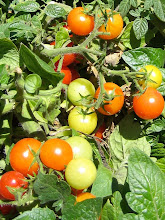
I've also had a great harvest (when I'm at the house, which hasn't been much) of tomatoes: Silvery Fir Tree (red, slightly ribbed) had about 100 tomatoes per plant, Yellow Cherry Cocktail was prolific with a long fruiting time and Yellow Pear is also going well. Then I have red Tommy Toe, orange Tigerella and red, ribbed Rouge de Marmande. I'm not sure the name of the other yellow tomato, similar size to Tommy Toe. I'm still waiting on the green Zebra (a mystery as I don't know which ones these are amongst the green tomatoes), Grosse Lisse and Black Russian to ripen.

I have made my own tomato relish out of 3kg of (mainly) Silvery Fir Tree tomato. Tomorrow is my 4th Annual National Tomato Sauce Making Day with friends (yes, I made this title up) and then on Sunday I'll do it again with Permaculture Inner North. Looking forward to it! Hard to get tomatoes this year: lots of rain and humidity=not many good tomatoes in Victoria. But I still managed to get my $20 for 20kg box. I don't have enough cooking tomatoes to make my own tomato sauce. They are more for salad.